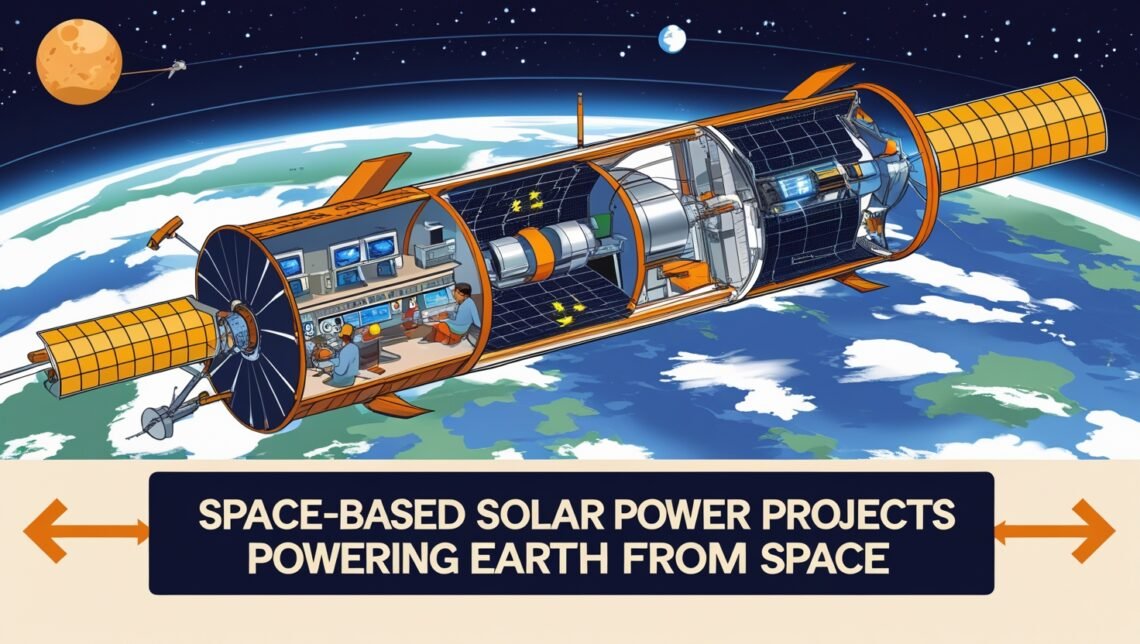
Imagine a future where the sun’s energy is harvested not on rooftops or sprawling farms, but from the vast expanse of space, captured in orbit and beamed down to Earth, offering endless clean power. This is the promise of Space-based Solar Power Projects. As the Earth faces growing energy demands and environmental challenges, the concept of Powering Earth from Space through the innovative capture and wireless transmission of solar energy stands as a bold, transformative solution. In this article, we explore how these ambitious projects are turning science fiction into a tangible, game-changing reality.
The Celestial Harvest:
At its core, space-based solar power is about collecting solar energy where it is most abundant, beyond the interference of atmospheric conditions and the cycle of day and night. In space, solar panels can capture sunlight continuously, converting it into electrical energy with unprecedented efficiency. By deploying satellites equipped with advanced photovoltaic arrays, engineers plan to collect vast amounts of energy that are then converted to microwaves or laser beams and transmitted wirelessly back to Earth. This revolutionary approach takes full advantage of space’s untapped solar bounty, providing a near-limitless source of renewable energy.
The concept has evolved over decades of research, spurred by the understanding that Earth-bound solar panels face limitations from weather, cloud cover, and the inevitable switch-off of solar input at night. With Space-based Solar Power Projects, these constraints vanish. The orbital environment offers stable, consistent, and intense sunlight, ensuring that energy collection is uninterrupted and reliable. This celestial harvest could one day power cities, industries, and entire nations with a clean, sustainable energy supply.
How It Works:
The technical heart of space-based solar power lies in the sophisticated technology that enables the collection and conversion of solar energy in orbit. Gigantic solar arrays, far exceeding the size of those on Earth, are deployed on satellites to capture the incoming sunlight. These highly efficient photovoltaic panels convert sunlight into direct current electricity. However, the innovation doesn’t stop there.
Once the energy is captured, it is converted into a form that can be transmitted across the void of space. The leading method involves transforming the electrical energy into microwave energy. Using advanced conversion equipment integrated with the solar panels, satellites generate a directed microwave beam. This beam is then precisely aimed toward a receiving station on Earth, known as a rectenna, where the microwave energy is reconverted into electricity and fed into the grid.
The entire process, from solar collection to wireless energy transmission, requires a marvel of engineering and coordination. It harnesses breakthroughs in materials science, ultra-lightweight structures, and high-efficiency power electronics. With ongoing advancements, the vision of Powering Earth from Space is gradually being sculpted into reality.
Wireless Energy Transmission:
Wireless energy transmission is the linchpin of space-based solar power. Unlike traditional power lines that lose energy over long distances, beaming power via microwaves or lasers offers the possibility of near-lossless transmission over thousands of kilometers. This method was demonstrated in key experiments where energy was successfully directed from orbiting prototypes to ground receivers.
Recent experiments have shown that flexible, lightweight microwave transmitters can be assembled into phased-array structures that direct energy beams with pinpoint accuracy. Safety is a paramount concern; engineers design these systems to keep energy levels well within safe limits, ensuring that the microwave or laser beams do not pose a risk to living organisms or interfere with other technologies. The goal is to create a controlled, efficient process where energy harvested in orbit can be seamlessly transferred to Earth, making the idea of Powering Earth from Space both feasible and transformative.
A New Dawn for Clean Energy:
The potential benefits of space-based solar power extend far beyond the realm of technological marvel. Environmentally, these projects promise a dramatic reduction in greenhouse gas emissions. Unlike fossil fuels, solar energy gathered from space produces no carbon emissions, offering an inexhaustible and clean source of power. By alleviating dependence on terrestrial energy sources, Space-based Solar Power Projects could play a crucial role in mitigating climate change and driving sustainable development across the globe.
From an economic perspective, the scalability of this technology is particularly promising. Once the initial infrastructure is in place, satellites can continuously supply energy without the intermittent issues that plague earthbound solar farms. Moreover, the modular nature of the designs allows for incremental upgrades and expansion, which can steadily reduce the overall cost per watt of energy delivered. In the long term, these factors can yield significant savings and stabilize energy prices, a win-win for both governments and consumers eager for reliable and affordable renewable energy.
Tackling the Technical Hurdles:
Despite the vast promise of space-based solar power, several technical and economic challenges stand in the way. One of the primary obstacles is the high cost of launching and assembling satellites. Constructing large, fragile arrays that can survive the harsh conditions of space requires cutting-edge materials and design innovations. Launch costs, although steadily decreasing thanks to advancements in rocketry, still represent a significant economic barrier.
In addition to cost, ensuring the efficiency and safety of wireless energy transmission is another major challenge. Microwaves and lasers must be accurately directed to avoid dispersal and loss over long distances. The alignment of transmitting satellites and ground-based rectennas must be meticulously managed to maintain the integrity of the energy beam. Moreover, there are regulatory and safety concerns related to transmitting high-energy beams through the Earth’s atmosphere, which require careful planning and international cooperation.
Nevertheless, these challenges are being actively addressed by research institutions and government agencies around the world. With continued investment and innovative problem-solving, the obstacles to Powering Earth from Space are steadily diminishing, paving the way for a new era of energy production.
Research and Development Breakthroughs:
In recent years, groundbreaking experiments and prototypes have reinvigorated the field of space-based solar power. Notably, projects spearheaded by institutions like the California Institute of Technology have demonstrated the potential of ultra-light, deployable solar arrays coupled with microwave beaming technology. Experiments such as the MAPLE (Microwave Array for Power-transfer Low-orbit Experiment) have successfully transmitted power between components in space, providing proof-of-concept that the envisioned system can work under actual conditions.
These pioneering efforts combine innovations in photovoltaics, wireless power transmission, and space robotics to create integrated systems that are both efficient and scalable. Researchers are continually improving the conversion efficiency of solar panels and the precision of microwave beams. As these technological pieces fall into place, the dream of Space-based Solar Power Projects becomes not only attainable but also an enticing possibility for meeting future global energy demands.
Moreover, international collaborations are beginning to take shape. Countries and private enterprises are pooling resources and expertise, recognizing that the successful implementation of space-based solar power could revolutionize global energy markets. By transcending national boundaries, these collaborations illustrate a shared commitment to a sustainable future where Powering Earth from Space is not just a scientific endeavor but a global priority.
The Global Impact:
The implementation of space-based solar power has the potential to fundamentally alter the global energy landscape. One of the most compelling prospects is the ability to deliver uninterrupted renewable energy anywhere on Earth. Unlike terrestrial solar farms, which are subject to cloud cover, weather variations, and the day-night cycle, satellites in orbit can provide a stable, continuous flow of energy. This reliability is especially crucial for regions with limited access to traditional power infrastructure.
In areas prone to natural disasters or long periods of darkness, the availability of space-derived energy could prove life-changing. It could power hospitals, schools, and communities that currently lack dependable electricity. By democratizing access to renewable energy, Space-based Solar Power Projects offer a powerful tool in the fight against energy poverty.
Furthermore, by reducing reliance on fossil fuels, this technology could help lower global carbon emissions significantly. The massive scale of solar energy available in space has the potential to meet or even exceed Earth’s energy needs, thus supporting economic growth while preserving the environment. In essence, the successful deployment of these projects would mark a pivotal moment in human history, a shift toward a global, clean-energy network that is as resilient as it is revolutionary.
Charting a New Course:
A critical aspect of advancing Space-based Solar Power Projects is the development of supportive policies and regulatory frameworks. Governments and international organizations must work collaboratively to address the challenges of space resource utilization, launch logistics, and airspace management. Establishing clear guidelines and safety protocols will be vital to the widespread adoption of this technology.
Public and private sectors are beginning to forge partnerships aimed at unlocking the potential of capturing and transmitting solar energy from space. As research progresses from laboratory prototypes to full-scale demonstrations, policymakers must create an environment conducive to innovation and investment. This includes incentivizing research, reducing regulatory burdens, and facilitating international cooperation to share both the risks and rewards of this groundbreaking technology.
Looking ahead, the next few decades could witness transformative changes in how energy is produced and distributed around the world. With continued advancements and supportive policy measures, the vision of Powering Earth from Space may soon become a cornerstone of global energy strategy. The convergence of science, technology, and policy in this arena promises not only a cleaner planet but also a more secure and prosperous future for people across the globe.
A New Frontier for Humanity:
The pursuit of space-based solar power encapsulates humanity’s enduring drive to explore, innovate, and overcome. It is a testament to our collective ambition to harness the resources of the cosmos for the betterment of life on Earth. By thinking beyond the confines of our planet, we open up possibilities that once belonged solely to the realm of science fiction.
This new frontier challenges traditional notions of energy production, encouraging us to redefine our relationship with the environment and expand our technological horizons. As we continue to push the boundaries of research and innovation, each breakthrough in Space-based Solar Power Projects offers a glimpse into a future where renewable energy is both ubiquitous and sustainable. In powering Earth from space, we are not only addressing one of the most pressing energy challenges of our time but also igniting a new era of exploration and discovery.
Conclusion:
The promise of Space-based Solar Power Projects lies in their potential to transform our energy systems by capturing the boundless energy of the sun and beaming it down to Earth. Through breakthrough technologies, carefully engineered wireless transmission, and global collaborative efforts, this vision of Powering Earth from Space is steadily moving from theoretical concept to tangible reality. As research advances and challenges are overcome, space-based solar power stands ready to usher in a cleaner, more reliable, and sustainable future, lighting up our planet with the very energy of the cosmos.
FAQs:
Q1: What is space-based solar power?
Collecting solar energy in orbit and sending it to Earth.
Q2: How is energy beamed to Earth?
Via microwave or laser transmission.
Q3: What are the key benefits?
Continuous, weatherproof, and clean energy.
Q4: What major challenge does the technology face?
High launch costs and precise energy transmission.
Q5: How does it impact the environment?
It reduces reliance on fossil fuels and cuts emissions.
Q6: What is the future potential? Transforming global energy supply with limitless renewable